Curioser and Curioser!
Sermon: May 31, 2026 . Unitarian Universalist Fellowship of San Dieguito
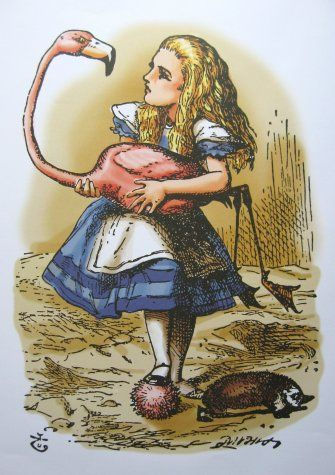
As we age, we wear our experiences like clothing. That time I learned that patience is necessary is now a soft, well-worn cotton shirt that is starting to fray along the collar. That time I found out that a broken heart can heal has become the socks that make my shoes a little more comfortable. That time I discovered that you can’t control the actions of others now hangs on me like a protective winter coat.
As I grow, I’ve put on more and more clothing, each layer adding to my understanding of how this world works. Each layer has the ability to shield and protect me from the world, like armor that I’ve acquired over the years, and yet, armor is heavy and restrictive. And sometimes I want to take it off.
The beauty of children lies in their effortless authenticity. They balance precociousness and vulnerability, and pose questions without armor and without shame because they aren’t prejudging the answer. This innocence is at the heart of Alice’s Wonderland journey. She’s thrust into an unconventional world that goes against everything she’s learned so far in her short life, and although she has started to understand societal norms and expectations, she is still young enough to openly question what she’s experiencing. Her questions range from the simple to the complex:
"Do cats eat bats? Do bats eat cats?”
"Would you tell me, please, which way I ought to go from here?"
"How do you know I'm mad?"
“Who in the world am I?”
Alice rarely gets answers that she understands, and is usually met with more questions to which she replies, “Curioser and curioser!” The lack of answers forces her to find meaning on her own. This is quite an adult concept, as children usually ask a follow up question, then another, until they get an answer that sufficiently suits their curiosity or until a parent says, “Because I said so.” Adults usually ask questions and don’t seem to get a sufficient answer, or at least not the one they want. This is one of the paradoxes of learning: that the more we learn, the more we find out there is to learn. Adults are also worried about appearing unintelligent and so often stifle their questions, but being unintelligent is different than being uninformed.
Less than one month after Albert Einstein’s passing in 1955, Life Magazine published an article called “Old Man’s Advice to Youth,” in which Einstein shared some final thoughts from his deathbed. He said “The important thing is not to stop questioning. Curiosity has its own reason for existence. One cannot help but be in awe when he contemplates the mysteries of eternity, of life, of the marvelous structure of reality. It is enough if one tries merely to comprehend a little of this mystery each day. Never lose a holy curiosity.”
A “holy” curiosity. This is an interesting choice of words for someone who dedicated his life to science. He described a holy curiosity as a spirit of humility, an open-minded search for truth, and a transcendental wonder. He believed that science and philosophy must travel together. As he said, “science without religion is lame; religion without science is blind.” One could rephrase this as “learning without wonder stops progress; and without learning, we are lost in wonder.” Alice, herself, goes back and forth between progressing through learning and being lost in a land of wonder. While it seems natural for children to spend their lives jumping back and forth between these two worlds, I think truly becoming an adult is realizing that you will never actually leave that in between place. You will always spend some time progressing and some time being lost in a land of wonder. How many times a day do we ask questions like, “Can you believe they did that?”or “Isn’t that remarkable?” to which usually I answer, “Yes, that is worthy of remark.” We especially react like this to negative things that we notice. “Why would they do that?” However, after we pose the initial question, we typically stop and then brush off the negativity and continue on with our day.
Sometimes, though, it can be hard to brush it off and we continue to carry it with us, another layer of clothing our frame has to bear the weight of. But remaining curious allows us to receive the lesson without the emotional weight that can come with it. The next time you find yourself saying, “Why would they do that?” follow that question with, “Why would they do that?” Ponder the options. Maybe they were late because of a circumstance out of their control. Maybe they aren’t feeling well. Maybe they didn’t mean it the way I heard it. Maybe they just forgot. Maybe… Curiosity can fuel our empathy and our compassion. It allows for space. In that space we can wonder, reflect, and process.
Not unlike Alice, we are entering a brand new world, where AI and technology will require that we keep flexible, curious minds. Regardless of how you feel about AI, it will answer some of your questions and proffer many more. It will require discernment: Do I believe what I’m being told? (We’ve already been practicing this in our current political and societal climate.) Remember to check your sources, and in the case of AI, double check them. This is a brave new world in which we will be faced with questions that humanity hasn’t yet had to answer. We will be like Alice, stumbling through Wonderland, pondering what it’s all about and wondering if we’re making any progress at all. This is the beauty of Alice’s story, that every generation feels like it is braving a new world, filled with wonder, learning, and growth. This is what keeps Alice relatable, for children as well as adults.
When in Wonderland, Alice spent significant time pondering. If we don’t take the time to be curious and to ponder, we won’t be able to process the weight of what we’re learning. Unlike Alice, we will not wake up to realize this has all been a dream. Instead, we must make sure our armor is lightweight and flexible. We must maintain a holy curiosity so that we are always ready to incorporate more knowledge and bend with this ever changing world.
Curiosity is what propelled Jonas Salk to discover the polio vaccine. It fueled Mozart in the creation of 600 works of music during his 35 years of life. Many other inventions you use today you can thank Curiosity for. The microwave was invented after Engineer Percy Spencer wondered why a candy bar melted in his pocket while working with radar equipment. Velcro was invented when George de Mestral wondered why burrs stuck to his dog's fur. Penicillin came about because Alexander Fleming wondered why an unwashed petri dish with spots of mold didn’t grow bacteria while he was away on vacation.
None of these things would exist if someone didn’t notice something and ponder it. And yet, we fill our days with to-do lists that remove pondering time from our lives and we are quick to react to something negatively instead of to wonder.
Pastor and author Carey Nieuwhof, suggests that the opposite of cynicism isn’t optimism, but curiosity. He says “Cynical people are rarely curious. On the other hand, curious people are almost never cynical.” While discernment is important, cynicism limits us and our thinking, and restricts understanding. It also seems to be a very adult concept. It’s rare to meet a truly cynical child. And one might say, “That’s because children are naive and don’t yet understand how truly complicated and difficult the world is. And it is difficult, especially when we react to it with pre-judgement and expectation. If we stop to truly see reality, to truly understand, then we can move forward without adding extra weight to ourselves. We can remain the truest sense of who were are, who we’ve always been, the child who notices, wonders, and asks questions.
May you find this world to be a Wonderland and may you marvel at its complexity and nuance. May you once again learn to live somewhere between understanding and wonder. And as you ponder all the questions this universe has to ask you, may you find it ever “Curioser and curioser!”
Amen.
OTHER READINGS FOR REFLECTION:
Posted on IG by @andfriendssss
"Somewhere along the way, we were taught that creativity required permission,
We were taught to wait until we’re ready. Until we’re polished. Until we’re “good enough.” So we stop ourselves before we even begin. We watch. We compare. And slowly, curiosity turned into caution. But curiosity doesn’t wait, it doesn’t ask for approval. It doesn’t care about outcomes. It doesn’t need an audience. It explores. Curiosity simply wonders. Being curious focuses on experience, not judgement. And experience is where the magic lives. Curiosity is how children learn. How musicians find melodies. How writers find their voice. How we find ourselves again."
"I think the key to the future is curiosity. I look at the people I admire most and they’re curious people, they’re open, they’re interested, they haven’t arrived."



Comments